- Details
- Created: Thursday, 25 July 2013 13:25
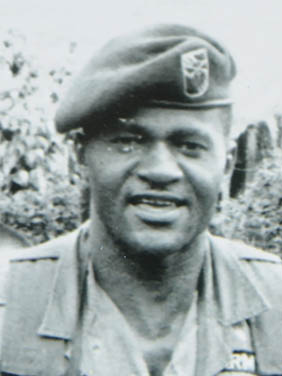
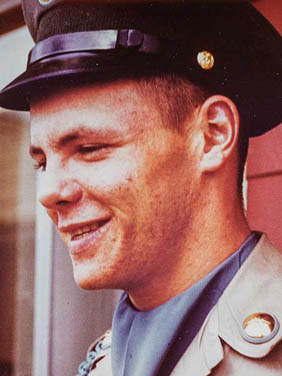
Lonnie Johnson of Flint, Mich., joined the U.S. Army on July 10, 1956, beginning a distinguished military career that lasted 30 years. His service started with the 720th Field Artillery Battalion at Fort Sill, Okla. After a number of years with different artillery units, he was transferred to the U.S. Army Special Warfare Center at Fort Bragg for training to enter the U.S. Special Forces. He graduated from training in 1962 and soon was assigned to the Republic of Vietnam as a member of the 5th Special Forces Group.
Empathy for the Vietnamese
In all, Johnson spent 5 1/2 years in Vietnam and Cambodia. He was involved in many actions, and in 1965-1966 he was a member of Detachment B-42 (5th SFG. ABN), based in the Chau-Doc province of Vietnam. When Johnson was not in combat, he spent time assisting the Vietnamese people. He understood poverty well, having been raised by his grandparents, who were share croppers on a farm in Alabama. They were so poor that he received only one pair of overalls to last a year, and his shirts were made from fertilizer sacks. When he saw the plight of the Vietnamese people, he tried to do everything he could to improve their lives.
A Helping Hand
When Johnson heard that a mother in the remote mountain village of Dongbathin was having difficulty with childbirth, he made his way to her home, carried her to a truck and raced to Camranh, where a Navy doctor successfully delivered the baby. On another occasion, after a Vietcong rocket attack killed eight Nhatrang civilians, Johnson found tin and wood to build the survivors a new home. One Christmas, he gave 1,500 orphans toothpaste, soap, candy and nuts collected from his fellow soldiers. Johnson loved the Vietnamese people and enjoyed interacting with them whenever he could.
Special Forces Training
Johnson attended many different special forces training schools and actually taught himself to speak the Vietnamese language, which was a real asset when communicating with the locals and interrogating captured prisoners. He also served as a member of the special forces training organization for the Cambodian “Forces Armee Nationale Khmer” (FANK) during his time overseas.
Homecoming Flights
One of the highlights of Johnson’s career came when serving with the 1st Special Forces Group (Abn). He was specially chosen to be a flight interpreter on flights to Hanoi after the North Vietnamese government agreed to turn over the POWs they were holding to the United States. In 1973, Johnson participated in many “Operation Homecoming” flights to North Vietnam and had the honor of placing a Green Beret on the head of Maj. Floyd Thompson, who was the longest-held U.S. prisoner of war.
Saving a Life
After the Vietnam War came to a close, Johnson’s exceptional service did not end. In August 1973, Johnson was parachuting over Okinawa with the 1st Special Forces group when a junior medic shot through his parachute like a bullet. The medic's chute had failed to open, and his reserve one malfunctioned. The medic grabbed hold of Johnson’s legs, but their parachutes were tangled. Johnson managed to free his chute in time, and they both hit the ground together very hard. Johnson suffered a dislocated shoulder and shattered a knee cap in the landing, but both men survived.
Further Heroics
On another occasion, Johnson was walking and heard a loud crack and looked up to see the outline of a man standing on a platform where there were three electrical transformers. The soldier had been stringing electrical wires. "There was a loud boom, and the man shot up like a rocket," Johnson said in describing the accidental electrocution. “He landed on the wires, and part of his body was dangling from the platform." Johnson quickly removed his field gear, leaving on his field jacket to help insulate himself from the wiring. He commanded two other witnesses to bring him two stripped-down pistol belts. He made his way up the utility pole carrying the two belts, "and when I reached the platform, I realized the man was really hung up in the wires," Johnson said. "There were several live wires, and some had broken loose and were thrashing around in the air. They were hot, and I had to watch my step up there." Johnson managed to fit one pistol belt around the victim’s waist and used the other to make a loop so he could pull the man free. The victim, Spec. 4 Guy Heffner, was unconscious. “He’s a big man, weighing almost 200 pounds,” Johnson said. "I had to lift him with my left hand and keep my balance with the other. In his unconscious state, he could not help me, so I prepared to bring him down alone." The fire department finally arrived and assisted Johnson in rescuing Heffner, who was evacuated immediately. His injuries were expected to cause permanent disability, but he was alive because of Johnson’s quick action. This is just another example of the type of soldier Johnson was.
Commander and Teacher
After he retired from the Army in 1986, Johnson began teaching military sciences at the Pusan American school’s Army Junior ROTC program and served as its commander for 13 years. He was well-liked by his students, who considered him as a father figure as well as their commander and teacher. Unfortunately, Johnson died unexpectedly on May 12, 2000, at age 66.
Our Collection
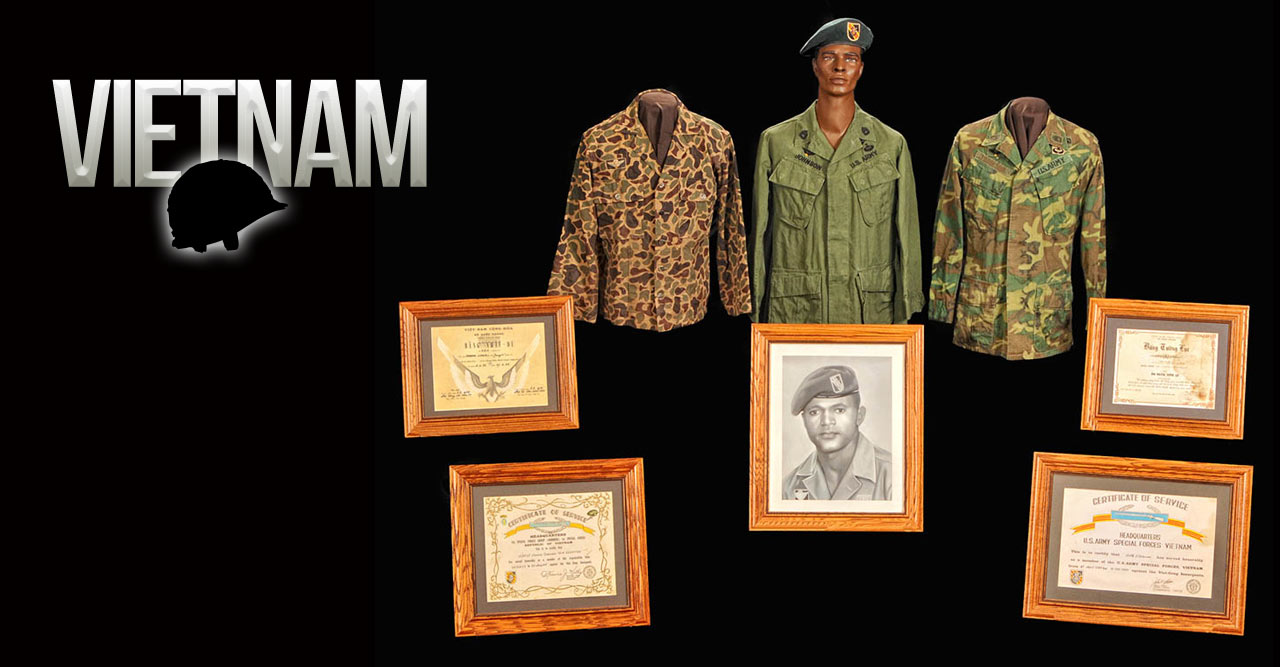
The Michigan Traveling Military Museum is pleased to have a very large portion of Command Sgt. Maj. Lonnie Johnson’s military estate in our collection. This fantastic grouping includes berets, books, documents, insignia, medals, presentation bolo knife, photo albums and color slides, uniforms, and many other items documenting his long and distinguished military career. In fact, we believe it to be one of the finest collections of its type in existence. It is a fitting tribute to a proud soldier who rose from a life of poverty and worked himself up to holding the prestigious rank of Command Sergeant Major. Our museum is pleased to own and display the Command Sgt. Maj. Lonnie Johnson Vietnam 5th Special Forces (Abn) grouping. This man is, without a doubt, “An American Story.”