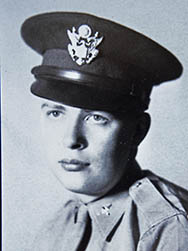
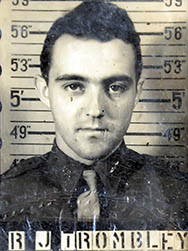
Raymond J. Trombley Jr. of Grosse Pointe, Mich., entered active military duty as a B-17 bomber pilot on May 20, 1943, and served with the 8th Air Force, based in England. He was attached to the 509th Bombardment Squadron (H) and 351st Bombardment Group (H). At age 21, he flew his first mission over the heavily defended target of Berlin, Germany.
'Never So Scared'
Trombley kept a detailed account of each one of his missions in his diary. The entry for this day read: "They woke us up at 2:30 this morning and flew my first mission and it was to Berlin. I saw two 17’s shot down and two FW-190’s shot down. I was never so scared in my life. I’ll bet I prayed 15 minutes straight." This was the first of many diary entries that chronicled the type of emotion and stress that was felt by these brave young men of the 8th Air Force.
Air Accolades
Trombley went on to fly a total of 32 missions (plus three bonus) over Germany and German-occupied territory, including the Normandy invasion coast on June 6, 1944. He was awarded the Air Medal on May 28, 1944, and added an Oak Leaf Cluster to it on June 11, June 30 and July 23, 1944, for a total of three clusters. On Aug. 5, 1944, he was awarded the Distinguished Flying Cross for extraordinary achievement while serving as a pilot of a B-17 airplane on a number of combat missions over Germany and German-occupied countries. One of the B-17’s he flew was named “Starduster” by the crew.
Our Collection
The Michigan Traveling Military Museum is pleased to have and display the 1st Lt. Raymond J. Trombley Jr. 8th Army Air Force B-17 pilots grouping. This excellent set includes his painted A-2 jacket, complete medal and insignia grouping, dog tags, diary, flight and personal military records. It is a tribute to a proud 8th Air Force veteran.
More from the Diary
Other interesting diary entries:
No. 4: "Got my fourth mission today. We started for Berlin but ended up bombing Kiel, Germany. The flak was heavy. We saw one ship go down, it wasn’t anyone we knew thank God."
No. 5: "They woke us up at 2:30 this morning and we went to Epinal, France. There were no fighters or flak but when we were forming a formation of B-24’s flew thru our group and a B-24 and B-17 hit each other. The B-24 blew up and both of them went down. That was awful and no one had a chance to get out. This made number 5."
No. 7: "I got number seven today. We went to Ochersleben Germany. It was a 7:30 hour trip and the flak and fighters were too darn good. The ship flying 20 feet below me was hit by fighters and went down over Germany. I was never so scared in my life. I saw those fighters coming in shooting at us and I thought that we were all finished, but I guess it wasn’t my day."
No. 15: "We went to Paris today. No. 15. I thought we had it for sure. A burst of flak hit off our right wing and we lost our No. 4 engine. Our group lost three ships. I saw one go down. He was hit in the No. 3 engine and started to burn. He left the formation and dropped down below. Flak hit him again and his right wing fell off and then it blew up. I think two of the crew bailed out. We had six holes in our ship when we got back. The main thing is we got back."
No. 31: "We got another one today. We went to Merseberg, Germany and bombed that gas plant again. But this time we saw some fighters. The 17’s got two of them and they got an B-17. They did not get very close to me thank God. I just found out I am flying deputy group tomorrow so I better get to bed. Glen Miller and his band were here tonight but I was sleeping so I missed him."
No. 32: "I wish I had some red ink to write this raid up. We went to Merseberg again and I hope this is the last time. I was very much in doubt as to whether or not we were going to get back. We hit the same target as yesterday. We picked up a couple of holes in our right wing by flak. One went through one of the gas tanks 10 minutes from the target. Fighters attacked us and we looked like a sieve when we finished. We lost No. 3 engine and almost lost No. 1. But we got back. Now only three to go and I’m scared stiff. The tail gunner, ball turret and upper turret gunner all got a fighter." No. 33: This was another rough one. We went to Munich again only this time we hit the target for a change. We didn’t have any fighter attacks on us today but flak knocked out our rudder controls and I thought we were all finished. Hoffman the Engineer wired it back together and we managed to stay in formation. Only two more and they can stick this combat up there ----!!"